Accounting's Glossary
Accounting.s Glossary.
I'm Gabrielle. I study at Ahuntsic College. I have been studying Accounting and management for 3 semesters now. My training prepares me for numerous positions, such as accounting technician for multinational corporations, private corporations, and non-profit organizations. We are also introduced to finance and management that create an opportunity for us, students, to be able to work for a company and be multifunctional. A lot of courses are needed for all that to happen, like macroeconomics and economics, news budget and financial analysis, organizational management, supply chain management, international trade, customer service and client approach, personal finance management and management statistics. To enter a good university, there is no competition. Good grades and being better than our schoolmates are what we need to have. So, there is indeed some competition, but it is again us. An internship, option is available. We have the opportunity to study in France with IUT du Havre at the end of our sixth semester, for our final stage.Things related to my program will be the subject of my blog. My future employers, friends, and people who seemed to be into management and Accounting should be checking out my blog. The first thing I will post is a glossary. A proper and interesting blog is what I will try to do. Since English isn't my first language, I'm going to make sure my language is good by using tools to improve my writing, like my teacher's help, my bilingual friends, and a virtual writing tutor. Discover and define key terms and definitions with the help of this glossary. The purpose of this guide is to aid both professionals and novices in comprehending accounting terms, which are not always the easiest to learn and comprehend. This guide will assist you in comprehending essential concepts such as balance sheet, turnover, gross margin, net profit margin, income statement, and many others. I created this glossary so that people who read my blog understand what I mean when I will talk about finance, accounting, and management. Little information, I found these terms in my accounting notebooks, in my courses as well as in digital dictionaries
- accounting
- noun
- The process of classifying, and summarizing financial transactions to provide information that is useful for people who will take decision.
- Example: To help your comprehension, here are 10 most common accounting terms with definition.
- en: comptabilité

- assets
- noun
- Assets are the possessions held by a company.
- Example: There are many examples of assets such as land, furniture, clients, cash and so on.
- en: actifs

- balance sheet
- noun
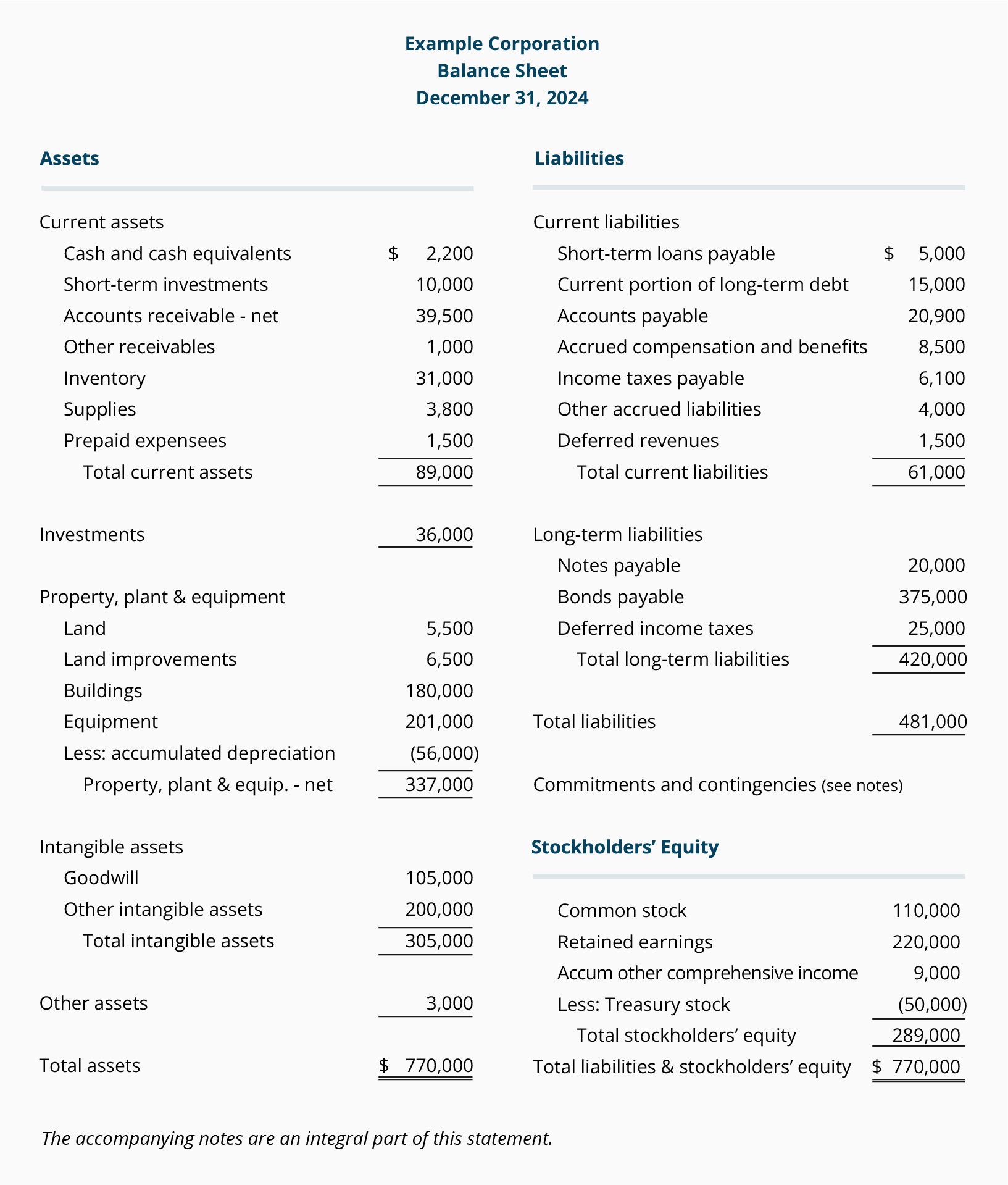
- The balance sheet is a record of a company's liabilities, assets, and equity. These are very large amounts because they show the money that the company has and the money it owes.
- Example: This is our company’s balance sheet. Liabilities are $450,000 and assets are $450,000.
- en: bilan
- bank reconciliation
- noun
- When both the cash side and the journals are balanced in the accounting accounts of a company, it is called bank reconciliation.
- Example: At the end of December, we must check if all of our check entered our bank account are equal to those who entered the general journal during the year.
- en: rapprochement bancaire

- budget
- noun
- A financial plan is a detailed account of the projected revenues and expenses of a business. It can help the company to see some potential on certain projects and can do the same on projects where not invest.
- Example: A company must write a budget to analyze the benefits and disadvantages of increasing production capacity and reducing employee wages to ensure that it always has a good net benefit.
- en: budget

- credit
- noun
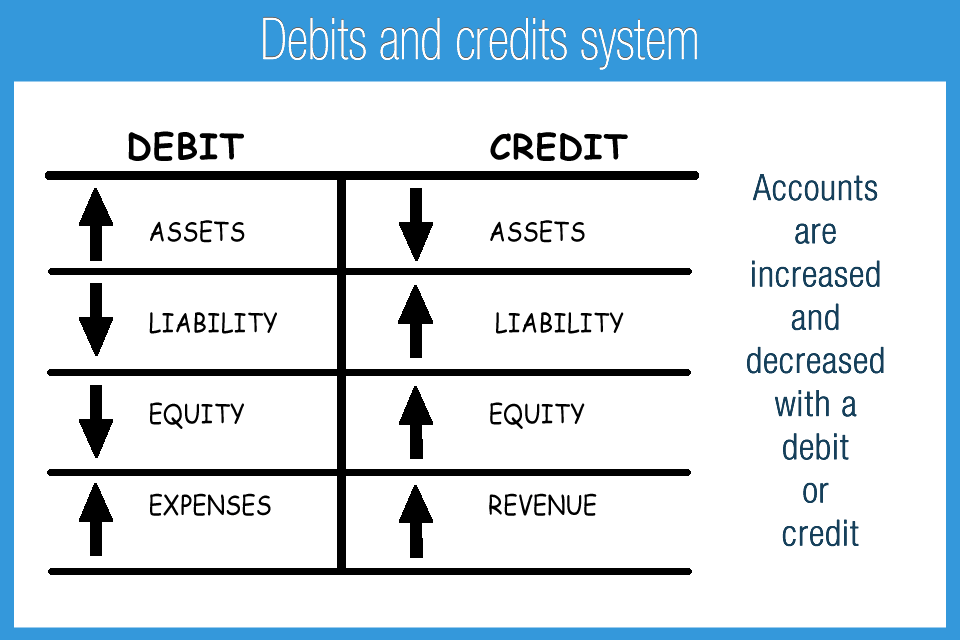
- A credit is a column in the general journal that is used to organize the money amounts of several accounts. This column is used by accountants to know whether the money in the account is increasing or decreasing.
- Example: We have acquired a product from our supplier. As the account increases to credit, the transaction will be written to credit in the supplier account and the transaction amount will be written to credit in the general journal.
- en: crédit
- debit
- noun
- A Debit is a column in the general journal that is used to organize the money amounts of several accounts. This column is used by accountants to know whether the money in the account is increasing or decreasing.
- Example: For example, the cash account increases when debited. We made a sale to a customer, so our money will increase, which will bring the cash account balance to the amount of the sale.
- en: débit
:max_bytes(150000):strip_icc()/debit-4198113-recirc-blue-1b26a301716d424387f86c5d3f3f9ea0.jpg)
- financial analysis
- noun
- It is an analytical process to ensure the finances of a company while allowing suggestions for changes that result in increased income of the company
- Example: An employee gives the idea of increasing the capacity to create merchandise, so it will be necessary to analyze whether this idea is good, if it is promising and will it increase the income of the company.
- en: analyse financière
:max_bytes(150000):strip_icc()/FinancialAnalysis-edit-5b5ae0fdcc92481e8d69fe30c92629f8.jpg)
- general journal
- noun
- It allows the recording of a company’s transactions. Whether it is a sale, purchase or transaction, it will be recorded in the general journal.
- Example: We will record the sale made to a customer in the general journal.
- en: journal Général

- general ledger
- noun
- The general journal is the most significant document for a company. It enables you to verify all transactions made during the year, month, or weeks. The activity of a company, including sales, purchases, refunds, and problems, can be observed as well as problems with our clients and providers
- Example: To update their accounts, we must check those of several customers and suppliers. Getting them in the ledger is the fastest option since their account balances are recorded there.
- en: le grand livre
:max_bytes(150000):strip_icc()/General-ledger-b821d06e18904b86b246c191d0adc447.jpg)
- inflation
- noun
- An item's average price may increase or decrease over a short period.
- Example: The market has experienced a $2.05 increase in the price of bananas since last year.
- en: le taux d'inflation

- inventory
- noun
- An inventory is all the goods useful for the company and those on sales
- Example: We have received new planks of wood, they should be listed in the inventory.
- en: inventaire
:max_bytes(150000):strip_icc()/TermDefinitions_Inventory_finalv2-174a95eaeac3409d971256da7ecb164b.jpg)
- liabilities
- noun
- Liabilities are all that the company has to pay.
- Example: For example, liabilities are a bank loan, payment of workers' salaries, housing, electricity, network etc.
- en: passifs
:max_bytes(150000):strip_icc()/liability_sourcefile-1f0b89893f674ff4b2e0f29c0748fe11.jpg)
- net income
- noun
- A net income is calculated by subtracting the sum of tax deductions and other mandatory deductions from the salary.
- Example: My salary this year is 60,500, but after taking all taxes for the full year, my net salary is 54,800.
- en: revenu net
:max_bytes(150000):strip_icc()/netincome-ad82b5ea402c4da3afcb362685f2710b.jpg)
- payroll
- noun
- This is the result of the payroll calculations for each employee, with the deduction of taxes.
- Example: Jeanne worked 40 hours per week for two weeks. She received a salary of $1050.23, yet her hourly wage is 15.50. She was deducted $189.77 in taxes.
- en: paie
:max_bytes(150000):strip_icc()/payroll-4191484-3x2-final-1-008077377d4a4d36bec1424f414b0d9d.png)
- petty cash
- noun
- The petty cash of a company is used for small recurring expenses. It usually has a maximum of $100.
- Example: One employee will buy iced coffee and donuts for all employees. This amount will be used from petty cash. If there is a lack of toilet paper or hand soap, the money to buy these small expenses will be taken out of the petty cash.
- en: petite caisse
:max_bytes(150000):strip_icc()/petty-cash-4191334-Final-2f5b5c6464e14d2d8a135dc21a096d73.jpg)
- profit
- noun
- A profit is a gain in money that the company makes when it sells one of its items. It is calculated in a way that the selling prices is higher than the buying price and when we take out the variable costs, we stay in positive.
- Example: We sold a TV for $850 and the profit we made on this TV is $450.
- en: profit

- receivables
- noun
- It’s a service to customers or suppliers. In fact, it’s a way of delivering the product or service without being paid. There is an agreement with the company and therefore the customer can pay 30 days after receiving the service.
- Example: We delivered goods containing 3 bikes, 2 trampolines and 10 alpine ski kits. The amount of $54,670 has not yet been paid to us as the customer has 30 days from the day on which he receives his order to pay us.
- en: créances recevables
:max_bytes(150000):strip_icc()/accounts-receivable-4202182-2-f6c551bb43d44a56b0950f1af70d1e05.png)
- the general ledger of clients
- noun
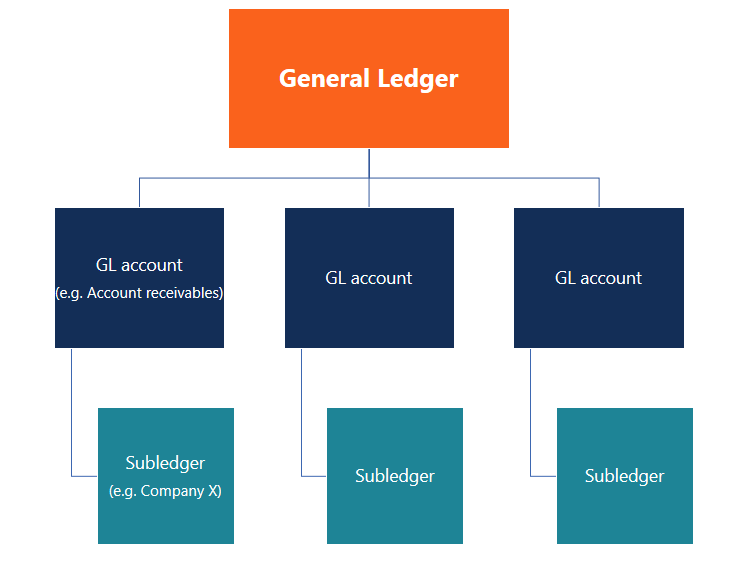
- The General Ledger of Clients is a book in which each client of a company has his own account with the records of transactions made with our company. It allows us to see if the balance is 0 or to make sure that transactions are up to date.
- Example: We will check whether April's transaction has entered the customer’s general ledger as his cheque must have been entered to the bank today.
- en: grand livre auxiliaire des clients
- the general ledger of supplier
- noun
- The General Ledger of supplier is a book in which each of our provider has his own account with the records of transactions made with our company. It allows us to see if the balance is 0 or to make sure that transactions are up to date.
- Example: We received the goods from one of our providers. We will check whether April's transaction has entered the provider’s general ledger as his cheque must have been entered into the bank today.
- en: le grand livre auxiliaire des fournisseurs
Comments
Post a Comment